
Quick answer: Progressive overload means gradually making your training harder so your body keeps adapting. You can add weight, reps, sets or training days, or improve your technique and range of motion. The simplest rule: once you beat your rep target on every set, add a small amount of weight next session.
You did the same three sets of ten for months, and somehow the dumbbells never got lighter. That isn't bad genetics. Your body adapted to the work and then politely stopped bothering. This guide shows you exactly how to keep asking it for more.
The idea isn't new. The American College of Sports Medicine's position stand on resistance training (opens in a new tab) treats progression as the foundation of any program that's meant to keep producing results.
What Is Progressive Overload?
Progressive overload is the principle that a muscle only keeps growing stronger when the demands on it keep rising. Lift the same weight for the same reps forever and you'll maintain what you have, but you won't build on it.
The key word is gradually. You're not trying to set a personal record every Monday. You're trying to make sure the trend over weeks and months points up.
6 Ways to Apply Progressive Overload
Adding weight gets all the attention, but it's only one lever. Here are six, roughly in the order most lifters should reach for them.
1. Add reps
Keep the weight and do one more rep than last time. This is the easiest place to start, especially with dumbbells, where the jumps between sizes can be large.
Example: Last week: 3 × 8 at 60 kg. This week: 3 × 9 at 60 kg.
2. Add weight
Once you can hit the top of your rep range on every set, add load. Small jumps work best: 2.5 kg on upper-body barbell lifts and 2.5–5 kg on squats and deadlifts.
3. Add sets
Doing more total sets per muscle each week increases training volume. A 2017 meta-analysis by Schoenfeld and colleagues (opens in a new tab) found a graded dose-response: more weekly sets produced more muscle growth. Our guide to how many sets per muscle group per week covers where to start.
4. Train more often
Hitting a muscle twice a week instead of once lets you spread out volume. A 2016 meta-analysis on training frequency (opens in a new tab) concluded that training major muscle groups at least twice a week is better for growth than once a week.
5. Improve technique and range of motion
A deeper squat or a pause on the chest during bench press is harder at the same weight. Cleaner reps count as progress, even when the number on the bar doesn't move.
6. Shorten rest (sparingly)
Less rest between sets makes the same work harder. It's useful for conditioning, but for strength, keep rest long enough to perform well. Cutting rest is the least reliable lever here.
How to Know When to Add Weight
Use the 2-for-2 rule, which comes from the ACSM position stand: increase the load by 2–10% when you can do one to two reps more than your target on the last set, two sessions in a row.
- Pick a rep range: for example, 3 sets of 6–8 reps.
- Start at the bottom: choose a weight you can lift for 6 reps with good form.
- Build reps: add a rep or two each session until every set reaches 8.
- Add load: increase the weight by the smallest step available and drop back to 6 reps.
- Repeat: that cycle is called double progression, and it works for almost every lift.
Weak: "Just lift heavier when it feels easy."
Strong: "3 × 6–8 on bench at 70 kg. When all three sets hit 8, go to 72.5 kg."
A Worked 8-Week Example
Here's double progression on the barbell row, starting at 60 kg for 3 sets of 8–10 reps. These numbers are an example, not a promise.
- Week 1: 60 kg × 8, 8, 8
- Week 2: 60 kg × 9, 9, 8
- Week 3: 60 kg × 10, 10, 9
- Week 4: 60 kg × 10, 10, 10 → add weight next time
- Week 5: 62.5 kg × 8, 8, 8
- Week 6: 62.5 kg × 9, 9, 8
- Week 7: 62.5 kg × 10, 9, 9
- Week 8: 62.5 kg × 10, 10, 10 → add weight again
Adding 2.5 kg feels tiny, right up until you've done it twenty times. Over a year, small, boring jumps add up to big ones.
How to Track Progressive Overload
You can't beat last session if you don't know what last session was. Your memory of last week's numbers is about as reliable as the gym's Wi-Fi.
Write down the exercise, weight, reps and how hard each set felt. Then compare by estimated one-rep max, which lets you see whether 62.5 kg × 8 is actually better than 60 kg × 10. Our guide on how to calculate your one rep max shows the formula.
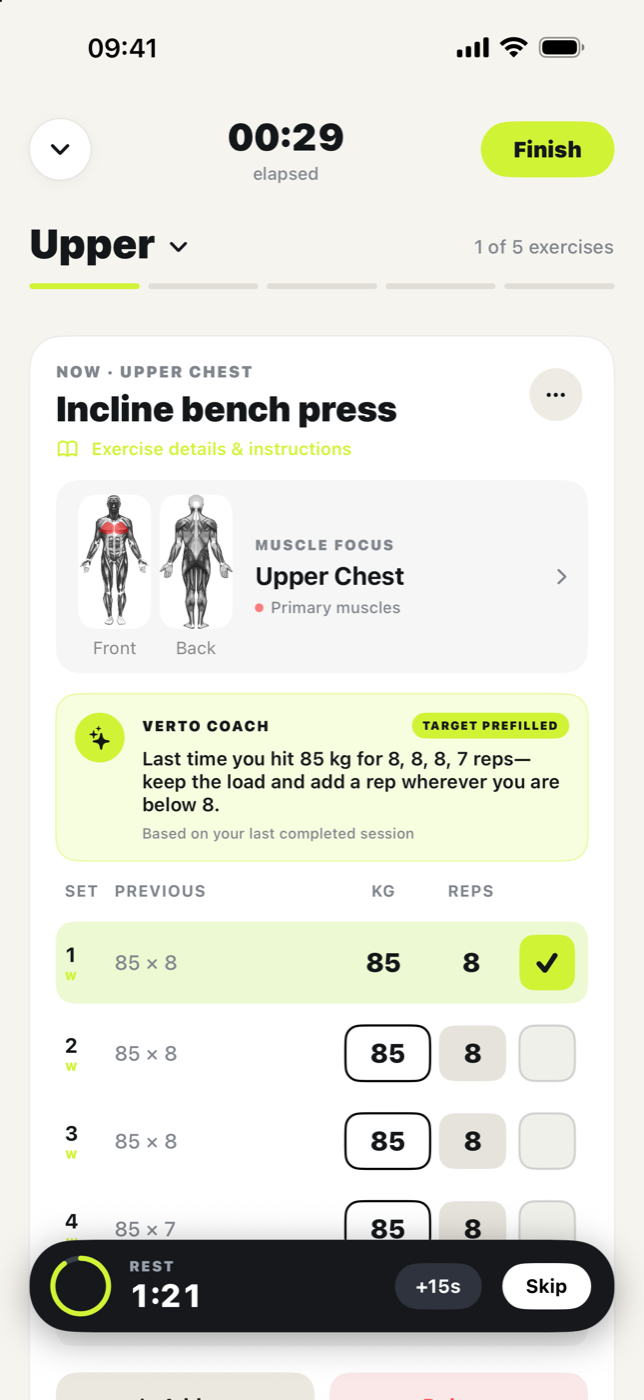
Verto does this for you. Every set is prefilled from your last session, and the strength charts track your estimated 1RM for each lift.
When Progress Stalls
Even good plans plateau. Before you change everything, check the basics:
- Sleep and food: progress slows when recovery does.
- Too much at once: adding weight, sets and exercises all at the same time is hard to recover from.
- Accumulated fatigue: if several lifts stall at once and every set feels brutal, you may need a lighter week. Our deload week guide explains how to run one.
Common Progressive Overload Mistakes
- Jumping too fast: big weight increases wreck your form. Small steps last longer.
- Changing exercises every week: you can't measure progress on a lift you never repeat.
- Ego reps: a half-depth squat at a heavier weight isn't progress. Hold the standard.
- Only chasing weight: reps, sets and technique count too, and they're often easier to improve.
- Not tracking: guessing turns progressive overload into hopeful overload.
Frequently Asked Questions
How fast should you progressively overload?
There's no fixed rate. Beginners can often add weight every session or every week, while experienced lifters may need weeks or months for the same jump. Add load when you beat your rep target, and judge progress over months rather than individual sessions.
Do you have to increase weight every week?
No. Adding a rep, a set or cleaner technique also counts as progressive overload. Many lifters stay at one weight for several weeks while reps climb, then add load. Forcing a weight increase every week usually leads to grinding reps and stalls.
Is progressive overload needed to build muscle?
Yes. Muscle grows in response to a challenge it hasn't fully adapted to. Without some form of increasing demand, such as more reps, weight or sets, results level off. Tracking your sessions in a workout tracker makes it easy to keep that demand rising.
Can you progressively overload with bodyweight exercises?
Yes. Add reps, slow the lowering phase, pause at the bottom, or move to harder variations, such as from knee push-ups to full push-ups to decline push-ups. You can also add a weighted vest or a backpack once the hardest variation gets easy.
Why have I stopped making progress?
The usual causes are poor sleep, eating too little, doing too much at once, or accumulated fatigue. Check those first. If several lifts stall together while every session feels very hard, a planned lighter week often gets progress moving again.
Start Tracking Your Progressive Overload
Progressive overload is simple: beat last time, a little at a time, and write it down. The hard part is remembering the numbers, so let your phone handle that while you handle the barbell. Verto's workout tracker prefills every set from your last session, so beating it is the only thing left to do.