
Quick answer: Most lifters build muscle well with about 10–20 hard sets per muscle group per week, split across at least two sessions. Beginners can start lower, around 6–10 sets. Research shows more weekly sets generally lead to more growth, but only if you can recover from them and keep progressing.
How many sets should you do? Ask five people at the gym and you'll get six answers, plus a lecture from the person curling in the squat rack. Weekly set count is actually one of the better-studied questions in strength training, and the answer is more practical than you might think.
A 2017 meta-analysis by Schoenfeld, Ogborn and Krieger (opens in a new tab) found a graded dose-response relationship: more weekly sets per muscle led to greater muscle growth, with 10 or more weekly sets doing best among the groups compared.
What Is Training Volume?
Training volume is how much work you do. People measure it in a few ways:
- Sets × reps × weight (tonnage): 3 sets of 10 at 100 kg = 3,000 kg. Useful, but it rewards light, high-rep sets in a way that doesn't match muscle growth well.
- Total reps: simple, but it ignores how heavy and how hard the reps were.
- Hard sets per muscle per week: the number of challenging sets each muscle gets in seven days.
Most research on muscle growth, including the studies below, counts weekly sets per muscle. It's also the easiest to plan and track, so it's the measure this guide uses. If your app shows weekly tonnage, that's fine too, but set counts make it easier to compare a heavy day with a light one.
What Counts as a Set?
Before counting sets, define what counts. For muscle growth, a set counts when it's a hard set: taken reasonably close to failure, usually within 1–4 reps of it, with good form.
- Counts: a working set of 8 squats where you could have done 1–3 more.
- Doesn't count: warm-up sets, or a set of 10 when you could have done 20.
Count a set toward each muscle that does most of the work. A bench press counts for chest. A row counts for upper back.
How Many Sets per Muscle Group per Week Should You Do?
Start in the middle of the range for your experience level, then adjust based on progress. These are starting points, not rules.
- Beginners (under ~6 months of consistent training): 6–10 hard sets per muscle per week. Almost anything works at this stage, so leave room to grow.
- Intermediates (~6 months to 2–3 years): 10–16 sets per muscle per week.
- Advanced lifters (several years): 12–20 sets, sometimes more for lagging muscles, with careful attention to recovery.
Example: An intermediate lifter targeting 12 chest sets per week might do 3 sets of bench press and 3 sets of incline dumbbell press, twice a week.
What the Research Says About Weekly Training Volume
Two findings shape most modern recommendations.
More sets tend to mean more growth, up to a point
The Schoenfeld meta-analysis pooled 15 studies and found that each additional weekly set was associated with a small increase in muscle growth. The study compared fewer than 5, 5–9 and 10 or more weekly sets per muscle. The 10+ group saw the largest gains.
That doesn't mean 40 sets beats 20. Returns shrink at higher volumes, and recovery becomes the limit. Most evidence-based coaches cap typical recommendations around 20 sets per muscle per week.
Spreading sets across the week helps
A 2016 meta-analysis on training frequency (opens in a new tab) found that training a muscle at least twice a week produced more growth than once a week. Ten sets in one session ends in sloppy reps. Two sessions of five is far more productive.
Strength-training guidelines agree on the basics
The CDC's physical activity guidelines for adults (opens in a new tab) recommend muscle-strengthening activity on at least two days a week, working all major muscle groups. Building muscle takes more than that minimum, but two days is a good floor.
6 Factors That Change How Many Sets You Need
The ranges above are averages. Your right number depends on a few things that move it up or down.
1. Training experience
Beginners respond to almost any training, so they need fewer sets to grow. As you get more experienced, the same workload becomes routine, and you often need more volume, more effort or both to keep progressing.
2. How close to failure you train
Sets taken close to failure deliver more stimulus each, so you may need fewer of them. Sets that stop far from failure count for less, which is why "I did 30 sets" can still mean very little. Stopping about 1–3 reps short of failure on most sets is a practical middle ground.
3. Recovery: sleep, food and stress
Volume only helps if you recover from it. Short sleep, eating too little or a stressful month at work all shrink the number of sets you can handle. During tough periods, holding volume steady or trimming it is a smart move, not a weak one.
4. Exercise selection
Big compound lifts, like squats and rows, are more tiring than isolation work, like curls and leg extensions. Ten sets of heavy squats feels very different from ten sets of leg extensions. If most of your sets are heavy compounds, you may recover better at the lower end of your range.
5. The muscle itself
Some muscles get plenty of indirect work. Triceps help on every press, and biceps help on every row and pull-up. Muscles like calves, side delts and rear delts get little help from compound lifts, so they usually need their own direct sets.
6. Your goal: muscle size or maximal strength
Weekly set targets are mostly about building muscle. If your main goal is lifting the heaviest weight possible, the type of sets matters as much as the number. The ACSM position stand on resistance training (opens in a new tab) recommends that advanced strength training eventually emphasize heavy loading in the 1–6 rep range, with 3–5 minutes of rest between sets.
In practice, strength-focused lifters often do fewer total sets per muscle, but more of them heavy, on the specific lifts they want to improve. Many people want both, and that's fine: build your week around a few heavy sets on the main lifts, then fill the rest of your volume with moderate-rep work.
Example: 3 heavy sets of 3–5 on bench press for strength, then 6–8 sets of 8–12 across incline press and flyes for size, split across the week.
Sample Weekly Plans by Set Count
Here's how weekly set targets translate into real workouts. Exercises are examples; swap freely.
Beginner: 3-day full body (about 6–9 sets per muscle)
Each session (Mon, Wed, Fri): squat 3 sets, bench press 3 sets, row 3 sets, Romanian deadlift 2 sets, lateral raise 2 sets
Weekly total: about 9 sets each for quads, chest and back, 6 for hamstrings and side delts
Intermediate: 4-day upper/lower (about 10–14 sets per muscle)
Upper (Mon, Thu): bench press 3, incline dumbbell press 2, row 3, pulldown 3, overhead press 2, lateral raise 3, curl 2, pushdown 2
Lower (Tue, Fri): squat 3, Romanian deadlift 3, leg press 2, leg curl 2, calf raise 3
Weekly total: about 10–12 sets each for chest, back, quads and hamstrings, 6 direct for side delts plus overhead pressing
Advanced: 6-day split (about 14–20 sets per muscle)
At this level, most lifters use a split that trains each muscle twice, such as the push pull legs split, with 6–10 sets per muscle in each session. Increase slowly, and watch recovery closely.
How to Split Your Weekly Sets
- Choose a weekly target per muscle: for example, 12 sets for chest.
- Divide by sessions: two sessions a week means about 6 sets per session.
- Cap per-session volume: around 6–10 hard sets per muscle per session works for most people. Beyond that, the extra sets tend to be lower quality.
- Spread across 2–3 exercises: different angles and movements share the load.
Weak: "Chest day: 20 sets of everything until I can't lift my arms."
Strong: "Chest: 6 sets on Monday, 6 sets on Thursday. Bench press and incline dumbbell press, 3 sets each."
Your split decides how this fits together. A push pull legs split run six days a week trains each muscle twice, which makes these targets easy to hit.
Do Secondary Muscles Count?
Compound lifts work more than one muscle. Bench press hits triceps and front delts; rows hit biceps and rear delts. A practical method is to count half a set for muscles that assist.
Example: 4 sets of bench press = 4 sets for chest + 2 sets for triceps.
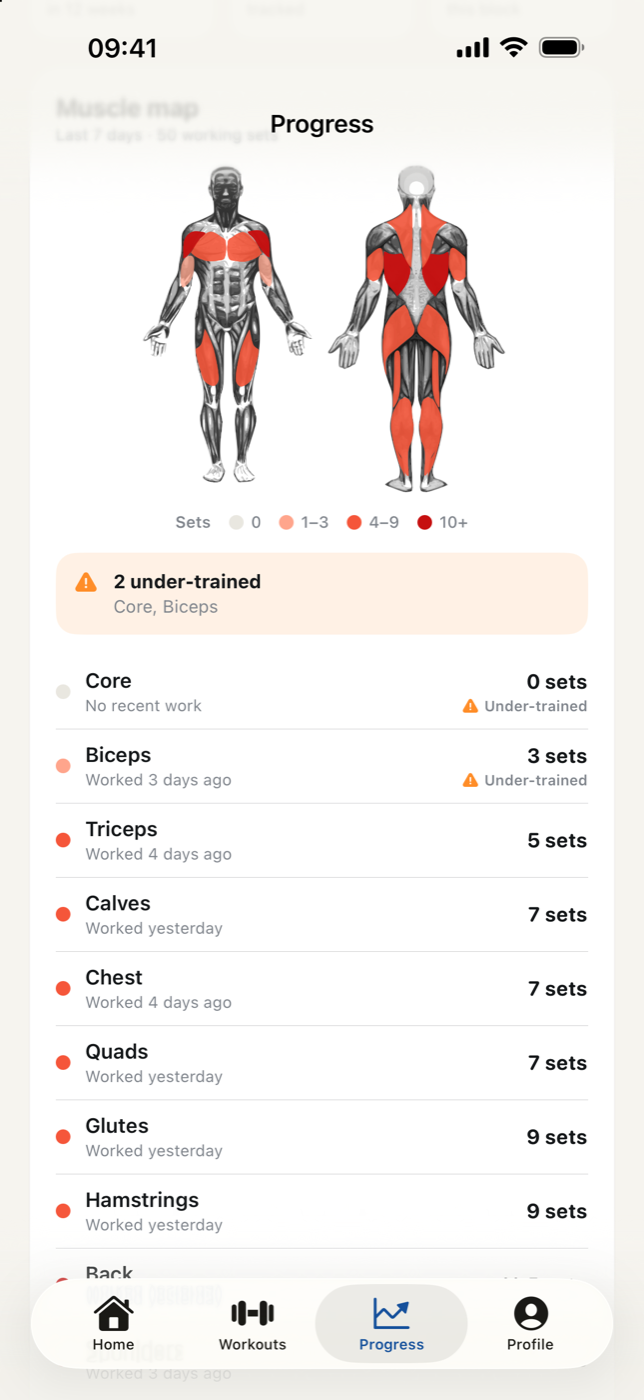
This stops you from accidentally doing 25 weekly sets for triceps when you only planned 10. It's the same method Verto's muscle map uses: secondary muscles count as half a set, and warm-ups don't count at all.
How to Know If You Need More or Fewer Sets
Your log tells you more than any chart. Track your sets and watch these signs over 3–4 weeks.
Signs you might need more sets
- Reps and weights are progressing slowly, but you recover easily.
- You're rarely sore and feel fresh every session.
- A specific muscle is clearly lagging behind the rest.
Signs you're doing too many sets
- Performance drops from week to week, even with good sleep and food.
- Lifts stall across the board, and everything feels heavy.
- Soreness lasts until your next session for that muscle.
If you're doing too much, cut sets by a third and see if performance rebounds. A planned deload week is a good reset point.
Cycle your volume instead of maxing it
Volume doesn't have to stay flat. A simple approach used by many coaches:
- Start a training block near the low end: for example, 10 sets per muscle.
- Add 1–2 sets per muscle every week or two: only while performance keeps improving.
- Deload when fatigue catches up: drop volume by about a third for a week.
- Restart a little higher than last time: if the previous block went well.
This way you find out how much work you can actually recover from, instead of guessing.
Track Your Weekly Sets Without a Spreadsheet
Counting sets per muscle by hand gets tedious fast, especially with compound lifts and half-sets. Here's a simple weekly check:
- Under 4 hard sets: likely under-trained. Add a few sets.
- 6–10 sets: solid for beginners and for maintenance.
- 10–20 sets: the productive range for most intermediates and advanced lifters.
Verto does this automatically. Its muscle map colors your body by working sets in the last 7 days and flags any group with fewer than 4 sets. Nobody has ever regretted writing a set down.
Common Training Volume Mistakes
- Counting warm-ups: they inflate your numbers without building muscle.
- Junk volume: easy sets far from failure don't count, no matter how many you do.
- Cramming everything into one day: split weekly sets across at least two sessions.
- Jumping volume too fast: add 1–2 sets per muscle at a time, not ten.
- Forgetting progression: volume helps, but you still need to add reps or weight over time. See our progressive overload guide.
Frequently Asked Questions
Is 10 sets per week enough to build muscle?
Yes. Ten hard sets per muscle per week is enough for most beginners and many intermediates to build muscle steadily. Research comparing weekly volumes found that 10 or more sets produced the most growth among the groups studied. Start there and add sets if progress slows.
How many sets per muscle group per week is too many?
There's no single limit, but more than about 20 hard sets per muscle per week is more than most people can recover from. If performance drops, soreness lingers or lifts stall across the board, you're likely doing too many sets. Cut back by about a third.
How many sets per muscle group per session?
Most people do best with about 6–10 hard sets per muscle in a single session. Beyond that, extra sets tend to be lower quality because of fatigue. If your weekly target is higher, spread it across two or three sessions instead of one long workout.
Do warm-up sets count toward weekly volume?
No. Warm-up sets prepare you for heavy work but aren't hard enough to drive muscle growth. Only count working sets taken reasonably close to failure. Apps like Verto mark warm-ups separately so they don't inflate your weekly totals.
Should beginners do fewer sets per week?
Yes. Beginners grow well on lower volumes, around 6–10 hard sets per muscle per week, because almost any training is a new stimulus. Starting low leaves room to add sets later, when progress begins to slow, instead of starting at a volume you can't recover from.
Count Your Weekly Sets With Verto
The right number of sets per muscle group per week is the most you can recover from while still getting stronger. For most people, that's 10–20. Finding your number takes data, not guesswork or a heroic 30-set chest day. Verto's muscle map counts your weekly sets for every muscle automatically and shows which ones need more attention.